Of all the reasons a Record of Appeal gets rejected at the registry, formatting is the most avoidable. Unlike a missed deadline or a procedural misstep that requires a court order to remedy, a formatting error is entirely within your control before you walk through the door.
This article covers the official Court of Appeal formatting rules on pagination and tenth-line numbering: what the Practice Directions actually say, what they mean in practice, and what happens when they are not followed.
Overview of the Court of Appeal Formatting Rules
The primary source for Court of Appeal formatting requirements is the Court of Appeal Practice Directions for Civil Appeals and Applications. These are not guidelines or suggestions. They are binding directions issued pursuant to the Appellate Jurisdiction Act, and the registry applies them strictly.
The two formatting requirements that cause the most rejections are page numbering and tenth-line numbering. They appear together in the Practice Directions and should be treated as a pair: a document that has one but not the other is still non-compliant.
Page Numbering Requirements
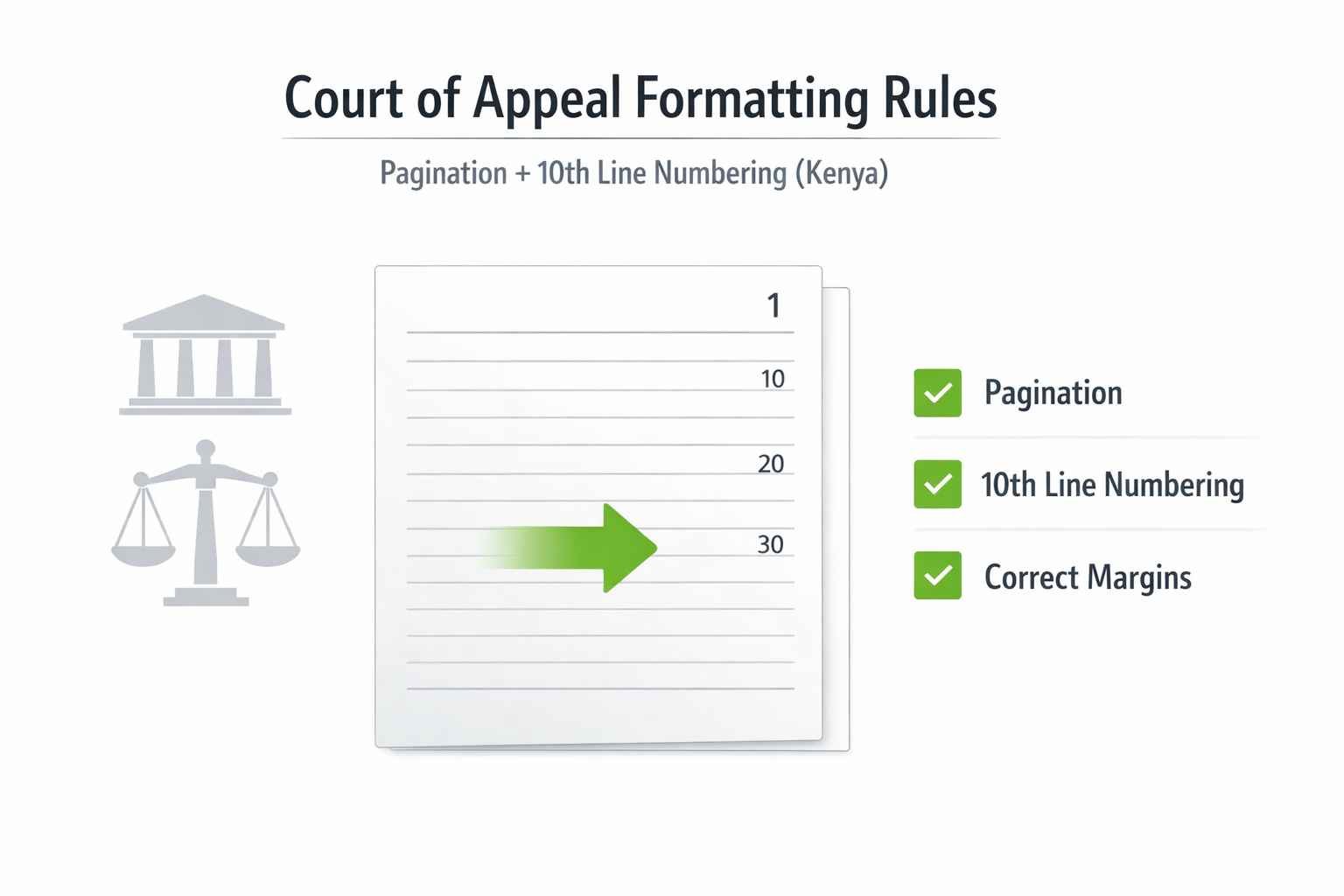
The Practice Directions are specific about where page numbers must appear. Every page of every document must be numbered at the top right-hand corner. Not the bottom. Not centred. Top right.
This matters because advocates preparing documents in Word sometimes rely on the default page number position set by their template, which is often bottom-centre. That is non-compliant regardless of how clearly the numbers are visible.
A few practical points on page numbering that the Practice Directions do not spell out but which registry practice has established:
- Numbering must be consecutive throughout the document. You cannot restart page numbering at annexures or exhibits; the entire Record of Appeal runs as one continuous sequence.
- Multi-volume records. Where a Record of Appeal spans multiple volumes, each volume carries its own consecutive sequence starting from page 1, with the volume number clearly marked on the cover.
- Margin and clearance. The page number must not overwrite or crowd the text. Rule 13(1) of the Court of Appeal Rules sets the left margin at 1.5 inches; ensure the top margin is also sufficient for the page number to sit clearly above the first line of text.
10th Line Numbering Requirement
The Court of Appeal Practice Directions state that every tenth line of every document shall be numbered in the right-hand margin. The Supreme Court Practice Directions 2020 contain identical language.
What this means in practice is that line 10, line 20, line 30, and so on on every page of your document must carry a corresponding number in the right-hand margin. The numbering restarts on each page, so line 10 on page 1 and line 10 on page 2 both show the number 10.
Three things are worth noting about how this requirement is applied:
- The margin placement is non-negotiable. The number must appear in the right-hand margin, outside the text area. A number squeezed between the last word of a line and the edge of the page is not compliant. The margin needs to be wide enough to accommodate the number clearly.
- Every document means every document. The requirement applies to the memorandum of appeal, written submissions, affidavits, and the Record of Appeal as a whole. It is not limited to the main pleading.
- Scanned documents are not exempt. If your Record of Appeal contains certified copies of lower court proceedings that were scanned rather than typed, those pages still require tenth-line numbering. This is where most multi-volume Records of Appeal fall short: the typed sections are numbered correctly but the scanned sections are left bare.
Other Key Formatting Requirements
Pagination and tenth-line numbering get the most attention because they are the most visible at the registry counter, but the Practice Directions cover several other requirements that are worth noting.
- One side of paper only. Documents must be printed on one side of the paper only. Double-sided printing is not permitted regardless of the environmental or cost considerations.
- Cover colour. All volumes must have covers of the same colour, with the volume number clearly marked on the front. The Court of Appeal Rules do not specify a particular colour for the appellant's Record; confirm the current expectation with your registry before filing.
- Binding. All documents must be bound in book form. Loose pages, ring binders, and spiral binding are not compliant. The binding must be firm enough that pages do not separate during handling.
- Volume limits. Where a Record of Appeal or application together with supporting affidavits and exhibits exceeds 500 pages, it must be bound in separate volumes each containing 500 pages or fewer. Each volume must contain an index of the documents in that volume.
Consequences of Non-Compliance
The registry is entitled to refuse to accept a document that does not meet formatting requirements. This is not a discretionary penalty; it is a straightforward application of the rules, and registry officers apply it consistently.
For a practitioner, a formatting rejection is also a professional embarrassment that is entirely avoidable. The rules have not changed. The registry has not changed. The only variable is preparation.